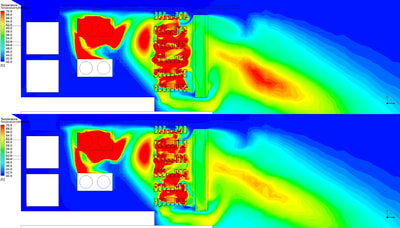
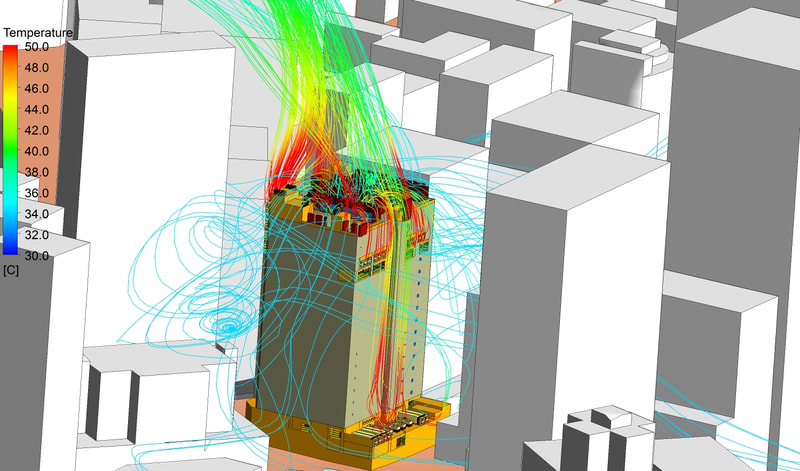
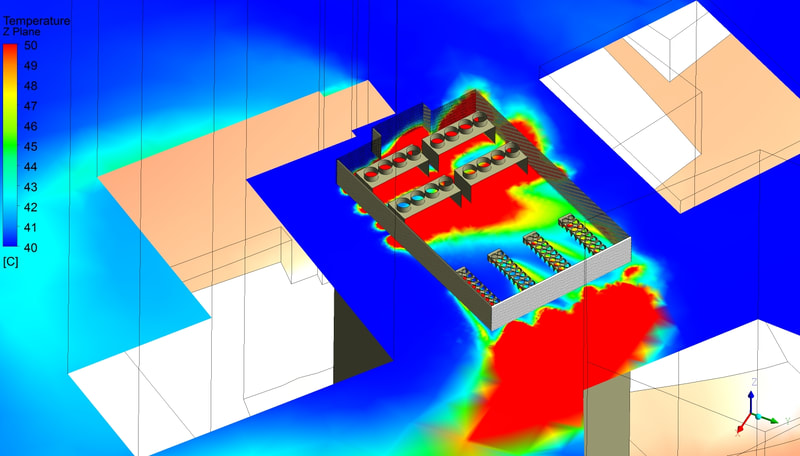
Energy Modelling for Data Centers can facilitate in design and use of facade materials, mechanical equipment, alignment and layout of building orientation.
Comprehensive control over all relevant factors is vital to achieve optimal performance and efficiency in a data center. Chokma Solution contributes to this goal by providing the CFD (Computational Fluid Dynamics) service for data centers, using its unique fluid dynamics expertise at the product level to make the CFD simulation more accurate at the application level.
The CFD simulations assist in the analysis, design, and optimization of data centers, resulting in reduced PUE (Power Usage Effectiveness) values, decreased annual energy costs, minimized carbon footprint, and lower yearly investment expenditure.
…more on CFD modelling
CFD modeling is essential for keeping data centers cool, optimizing cooling performance to maximize efficiency and sustainability. Data centers consume a significant amount of electricity, contributing to approximately 2% of total electricity use in the US and 1-1.5% globally. The increased demand for power loads and sophisticated applications generates heat that needs efficient dissipation, making thermal management a priority.
Computational fluid dynamics (CFD) is a key tool in understanding the physics of cooling in data centers. By using CFD methods like Ramboll’s Digital Wind Tunnel (DWT), it is possible to simulate and analyze the airflow and heat transfer within a data center before construction, providing insights into cooling performance under various conditions.
CFD allows for virtual testing of cooling systems at different design stages, ensuring that the cooling design can meet demands and reduce energy consumption. It is particularly beneficial for designing larger data halls where efficient layout and operation of cooling systems are crucial for year-round operation.
By partnering with a hyperscale data center company, Ramboll was able to study and verify design concepts for a mission critical facility using CFD simulations. The simulations helped identify and fix design issues before construction, ensuring optimal airflow and cooling performance during extreme conditions.
Design optimization through CFD simulations can prevent heat rejection issues that compromise operational efficiency, ensuring that data centers can maintain peak performance even in high ambient temperatures. Failure to meet design thresholds can lead to increased energy use and economic losses, making CFD modeling an essential tool for data center design and management.
As a new WordPress user, you should go to your dashboard to delete this page and create new pages for your content. Have fun!